Module 5: Course Management Thinking / Lesson 2 of 5
Green, Yellow and Red Light Pins
Lesson 2 of 5
What To Do
Not every pin is an invitation. JJ teaches his players to begin to recognize when they can go for the pin and when they can't, using a traffic light. Green Light means attack the pin. Yellow Light means the middle of the green on a conservative line. Red Light means find somewhere safe, an easy up and down, or maybe a long putt.
The light depends on your shot pattern. Here is JJ's example for a player who fades the ball: back left pins are more difficult because the ball curves away from them. Accept that a 15 to 20 footer right of the hole is the right shot, rather than aiming left of the pin at the short side and trying to hit it perfect. Aim right at the pin. If you pull it you are fine, if you hit it perfect you are 10 to 15 feet away, and if you push it you have 40 feet, but from the strong side.
How To Do It
Step 1: Know your pattern
Which way does the ball curve when you hit it well? Which way does it go when you miss? Write both down. Your pattern decides which pins are green and which are red.
Step 2: Check where trouble is
Before you pick a target, look for water, deep bunkers and short-sided spots. If the pin sits close to trouble on the side your miss goes, it is a red light.
Step 3: Call the light out loud
Say "green," "yellow" or "red" before you pull a club. Calling it makes the decision clear, and a clear decision gives your routine a useful starting point under pressure. That is JJ's first strategy: decide before you swing.
Step 4: Aim at the fat side
On yellow and red lights, aim for the biggest part of the green. A 25 footer is a two-putt most of the time. A short-sided chip out of a bunker is not.
Step 5: Practice it on the course
JJ's on-course practice: play 2 balls and take the worse one, or play with one club plus a wedge and a putter. Call a light for every approach. Playing worst ball shows you very quickly which pins you have no business attacking.
Track your decisions on the card
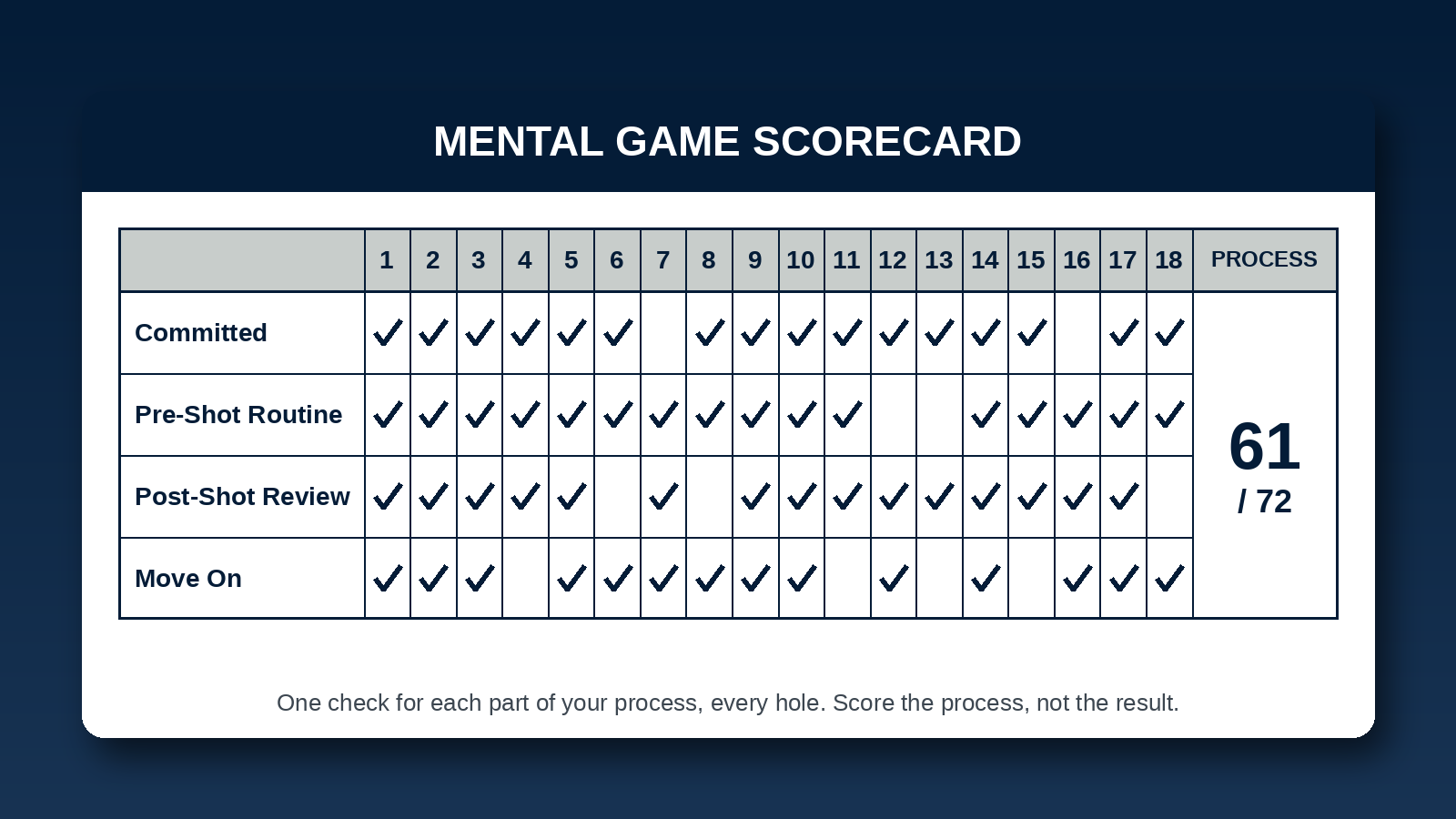

Everything you save here is stored in My Playbook.
When To Use It
- On every approach shot before you choose a club
- On par 3s with tucked pins
- During practice rounds when you play 2 balls worst ball
Common Mistakes
- Treating every pin as a green light
- Aiming at the short side and hoping to hit it perfect
- Ignoring your own shot pattern when picking a target
- Changing your mind over the ball after calling the light
Practical Exercise
Call the Light Breath
Do this behind the ball once you have called the light. Breathe in for 4 and see the target. Hold for 4 and confirm the light. Breathe out for 4 and let go of the pin if it is red. Hold for 4 and commit.
Pattern: 4-4-4-4 seconds, 2 cycles. The voice counts each second for you.
Ready
Takeaways
- Green attack, yellow middle, red safe
- Your shot pattern decides the light
- A 20 footer from the strong side beats a short-sided chip
- Decide before you swing
- Worst ball practice shows you which pins to leave alone
Reflect
Use It Next Round
Something not going right on the course?
Tell the AI Coach what happened and get exercises picked for you.
Finished the lesson? Mark it complete to track your progress.