Lesson 5 of 5
What To Do
Bob Rotella said, "It's not what happens to golfers, but how they choose to respond to what happens, that distinguishes champions." Most of the focus in golf is on the pre-shot routine. JJ says the post-shot routine is equally, if not more, important. It happens right after you hit the shot, when you have an emotional reaction to the result.
Why could it be more important? Because this is when you gather feedback and learn about your game. If you evaluate and learn from every shot, imagine how much faster you will improve compared with hitting a shot, throwing your club and walking to the next one. JJ lists four benefits: you gather feedback, you speed up learning, you move on to the next shot with no emotion, and you understand your game better.
You started this in Module 1, Lesson 4 with the three ways to file a shot. Now you add JJ's four questions so every shot teaches you something.
How To Do It
Step 1: Prepare for failure
In golf you will hit more bad shots than good ones. Prepare for them before the round so they do not surprise you. A bad shot is not a sign that something is wrong. It is part of the game.
Step 2: Ask the four questions
After every shot ask: What was I trying to do? How well did I execute what I was trying to do? Why did I execute it that way? How will I reinforce it or fix it?
Step 3: File it in one of three boxes
Great shot: enjoy it. Acceptable: farther from the hole than you wanted, but in a safe spot with good odds for par. Learning experience: not the result you wanted. Do not get angry. Learn from it and rehearse the swing you wanted to make.
Step 4: Start with commitment
In JJ's on-course version the first question is, "Was I 100% committed and did I run my routine with confidence?" If no, find what in your routine got in the way and make a perfect routine your only goal on the next shot. If yes and it was good, name what you did well and make one practice swing to lock it in. If yes and it was bad, name the result and the swing flaw, make the swing you intended, and put the club away.
Step 5: Put the club away and switch off
JJ says this is really hard for most players. They want to dwell on a bad shot and overthink it. Once the club is in the bag, put your focus on something outside of golf until you reach your next shot. Write down your post-shot routine and carry it with you to the range and the course.
Score your post-shot routine every round
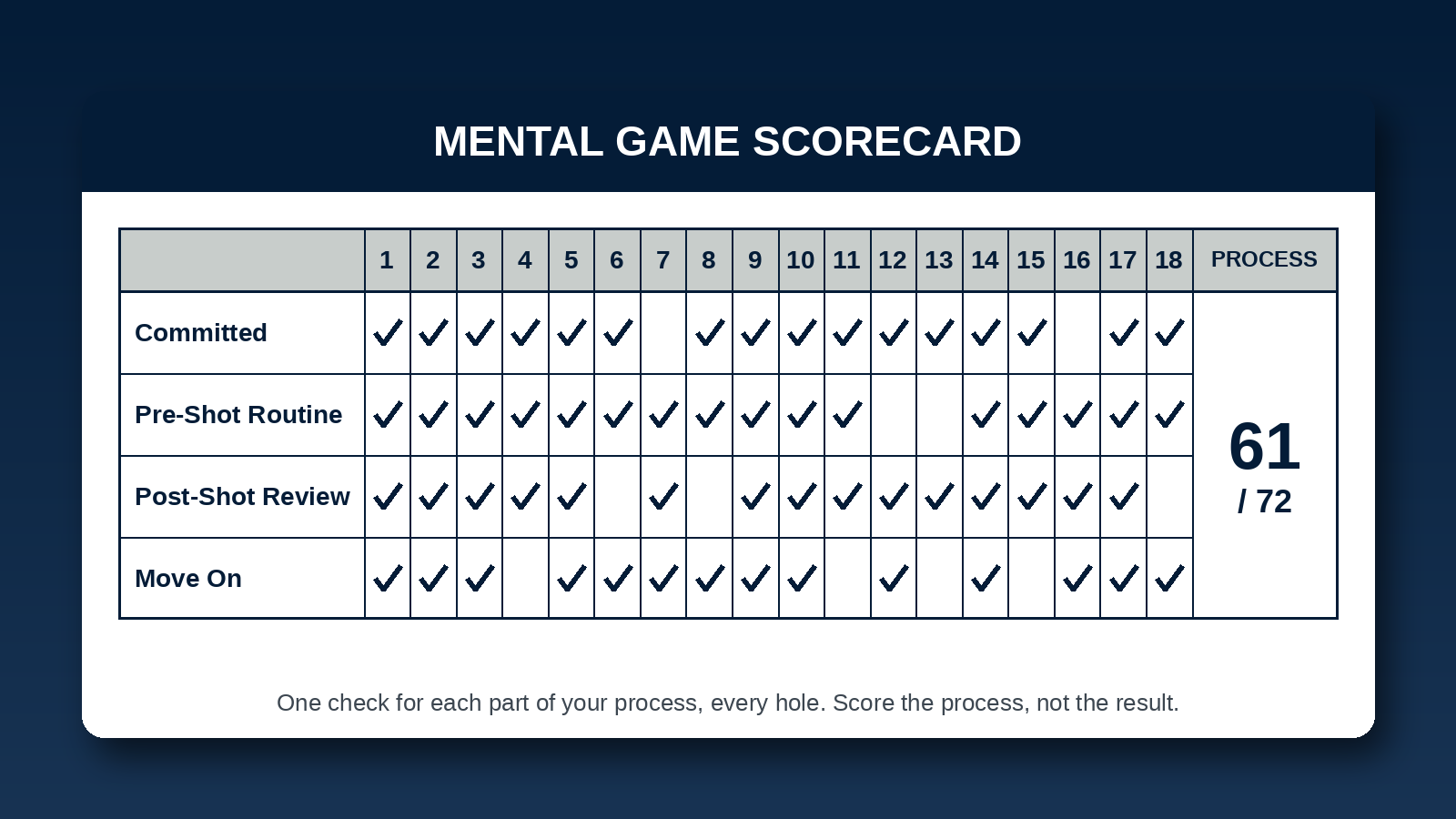
Everything you save here is stored in My Playbook.
When To Use It
- After every shot, good or bad
- Especially after a learning experience when you feel the anger rising
- In practice, during the final third of every session
Common Mistakes
- Only having a pre-shot routine and reacting however you feel after the shot
- Skipping the questions after good shots and missing the chance to reinforce them
- Thinking about swing positions after a shot you were not committed to. Fix the routine first
- Carrying the shot to the next tee instead of putting the club away
Practical Exercise
Close the Book Breath
Use this as the club goes back in the bag. Breathe in for 4 and name the box: great, acceptable or learning. Hold for 4 while you answer how you will reinforce or fix it. Breathe out for 4 and let the shot go. Hold for 4 and think about something outside of golf.
Pattern: 4-4-4-4 seconds, 2 cycles. The voice counts each second for you.
Ready
Takeaways
- How you respond to a shot matters as much as how you hit it
- Four questions: what was I trying to do, how well did I do it, why, and how will I reinforce or fix it
- Not committed? Fix the routine, not the swing
- Great, acceptable or learning experience. Every shot fits one box
- Put the club away and switch off between shots
Reflect
Use It Next Round
Something not going right on the course?
Tell the AI Coach what happened and get exercises picked for you.
Finished the lesson? Mark it complete to track your progress.