Lesson 2 of 5
What To Do
The thinking part of your routine and the playing part need a clear border. Behind the ball you analyze, choose and see the shot. Once you step across your decision line, the thinking is done and your only job is to execute with 100% commitment. That is one of JJ's non-negotiables: a clear plan and 100% commitment to the plan you chose.
JJ trains this with his Mental Game Scorecard, a self-evaluation of your routine and commitment on each shot. He calls it how you practice and learn how to trust it over each shot. The grade is never based on the result. A great shot you hit while doubting your club gets a low grade. A missed green after a fully committed swing can get a 10.
How To Do It
Step 1: Make the line physical
Pick a real line. Some players use an imaginary line a step behind the ball. Others use the moment they put the glove on or take the headcover off. Once you cross it, you are done deciding.
Step 2: Decide fully behind the line
Finish your analysis behind the line: lie, wind, distance, flag color, landing spot and club. If you are between clubs, decide which one and the swing that goes with it before you step in.
Step 3: If a doubt shows up, back off
JJ's instructions: when swing thoughts enter your mind, let them go. Do not dwell on them or act on them. Back off and restart your routine. Do the same when your score or a fear enters your mind. When you restart, set up your deep belly breathing to help you relax and be athletic. Backing off costs ten seconds. Hitting a shot you do not believe in costs a stroke.
Step 4: Grade every shot from 1 to 10
Right after each shot, grade yourself 1 to 10 on how well you ran your routine and trusted your swing. A 1 is terrible, like worrying about the water on the left and swinging while hoping for the best. A 10 is perfect, 100% comfortable with only the steps of your routine in your mind. Write it down right away. If you wait until the end of the hole, you will not grade the earlier shots accurately.
Step 5: Find your average
Add up all your grades and divide by the number of shots you graded. JJ's example is 521 divided by 79, an average of 6.6. Do not keep your golf score during this exercise. Write notes about your thoughts in as much detail as you can. JJ calls this the best way to get absorbed in your routine and the process.
Score the four checks every hole
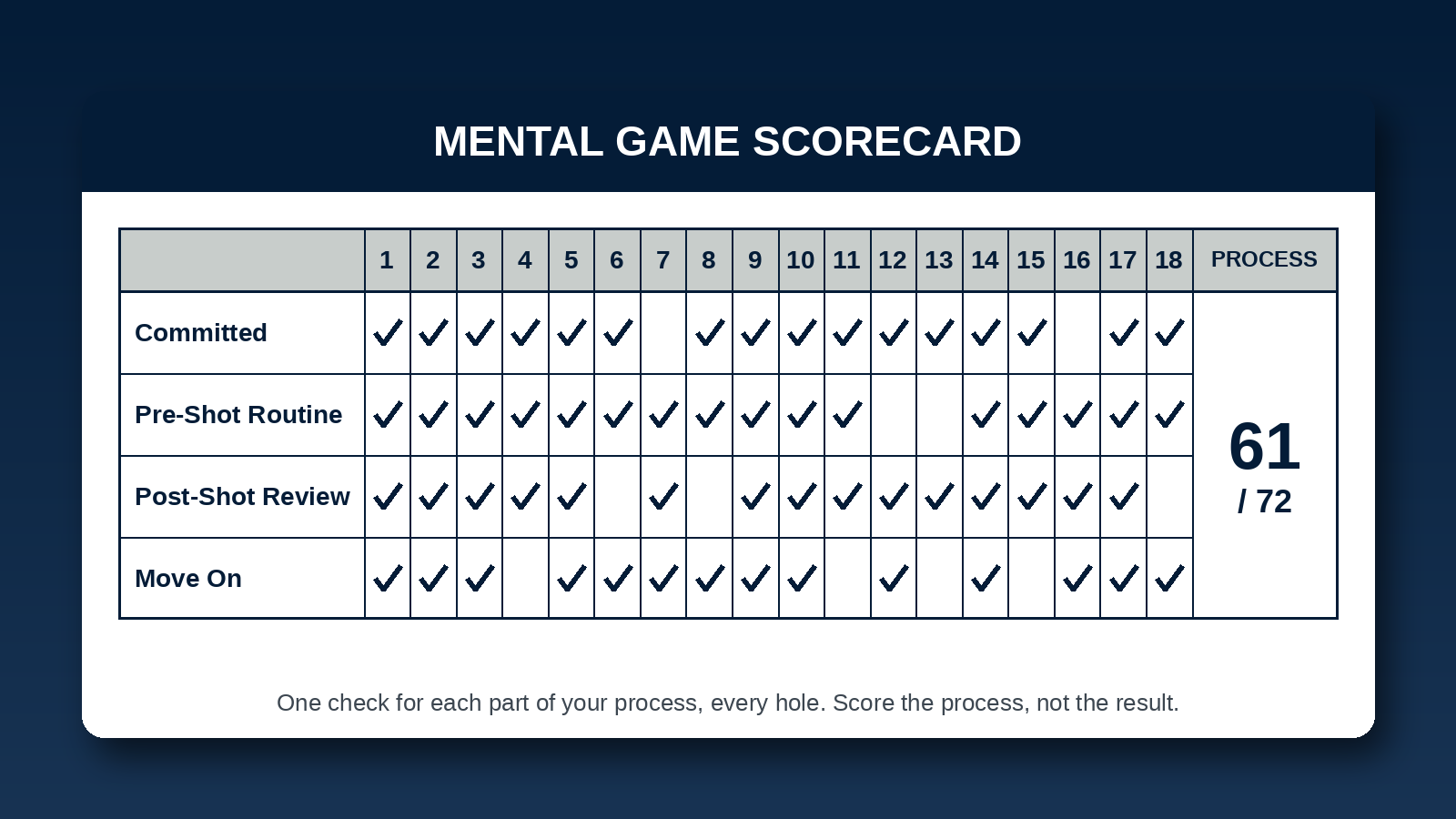
Everything you save here is stored in My Playbook.
When To Use It
- On every shot, especially when you are between clubs or facing trouble
- When a swing thought, your score or a fear pops up over the ball
- Once a week, play a round with the Mental Game Scorecard as your priority
Common Mistakes
- Still deciding while standing over the ball
- Feeling guilty about backing off, so you hit it anyway
- Grading the result instead of your routine and commitment
- Waiting until the end of the hole to write down your grades
- Keeping your golf score during the exercise
Practical Exercise
Restart Breath
Use this every time you back off a shot. Step behind the line, breathe in for 4, hold for 4, breathe out for 4, hold for 4. JJ's rule is to set up your deep belly breathing every time you restart, so your body is relaxed and athletic when you step back in.
Pattern: 4-4-4-4 seconds, 2 cycles. The voice counts each second for you.
Ready
Takeaways
- Think behind the line, play across it
- A clear plan and 100% commitment are non-negotiable
- Swing thought, score or fear over the ball? Back off and restart with a belly breath
- Grade the routine and the trust, never the result
- Your average grade shows how well you are learning to trust it
Reflect
Use It Next Round
Something not going right on the course?
Tell the AI Coach what happened and get exercises picked for you.
Finished the lesson? Mark it complete to track your progress.