Module 1: Identity and Confidence / Lesson 4 of 5
Own Your Swing: The Post-Shot Routine
Lesson 4 of 5
What To Do
Most golfers lose confidence because they start fixing their swing in the middle of a round. One loose shot and suddenly they are thinking about takeaway, grip, and hip turn all at once. The swing gets tight and mechanical, and the next shot is worse. Owning your swing means you bring one swing to the course and you play with it.
The tool that makes this work is a post-shot routine. After every shot you check one thing first: did I commit 100% to that swing? If you did not commit, the swing was not the problem. If you did commit and the ball still went somewhere you did not want, you look at feel in your hands and the clubface, because roughly 80% of where the ball starts comes from where the face points at impact. You only change a swing thought after several fully committed shots miss the same way.
This lesson also helps you build two things every good player has: a clear picture of your tendencies and miss direction, and a go-to shot you can lean on when things are not going well.
How To Do It
Step 1: Run the post-shot checklist
After every shot, before you pick up the tee or walk off, ask: Did I commit 100%? What did I feel in my hands? Where did the face point? Then accept the result and let it go. Use the Post-Shot Checklist below until it becomes automatic.
Step 2: Follow the swing thought rule
Do not change your swing thought because of one bad shot. Only make an adjustment after you hit multiple shots that you were 100% committed to and they all missed the same direction. If you were not committed, recommit. Do not rebuild.
Step 3: Combine your swing key with tempo and feel
Pick one swing key, pair it with a tempo and a feel, and be aggressive to smart targets. Aggressive does not mean firing at every pin. It means a full, committed swing at a target that leaves room for your normal miss.
Step 4: Know your tendencies and miss direction
Write down your typical miss and which direction it goes, plus the situations that bring it out. When you know your miss, you can aim so that it stays in play instead of fighting it shot by shot.
Step 5: Build your go-to shot
You need one shot you trust when the round starts to slip, a shot you know you can hit. For many players it is a punch cut: ball slightly back, hands ahead, shorter finish, face held open through impact so the ball cannot turn left. Write your setup keys, swing thought, and feel in the My Go-To Shot form below and practice it until it is automatic.
Step 6: Keep a Mental Game Scorecard
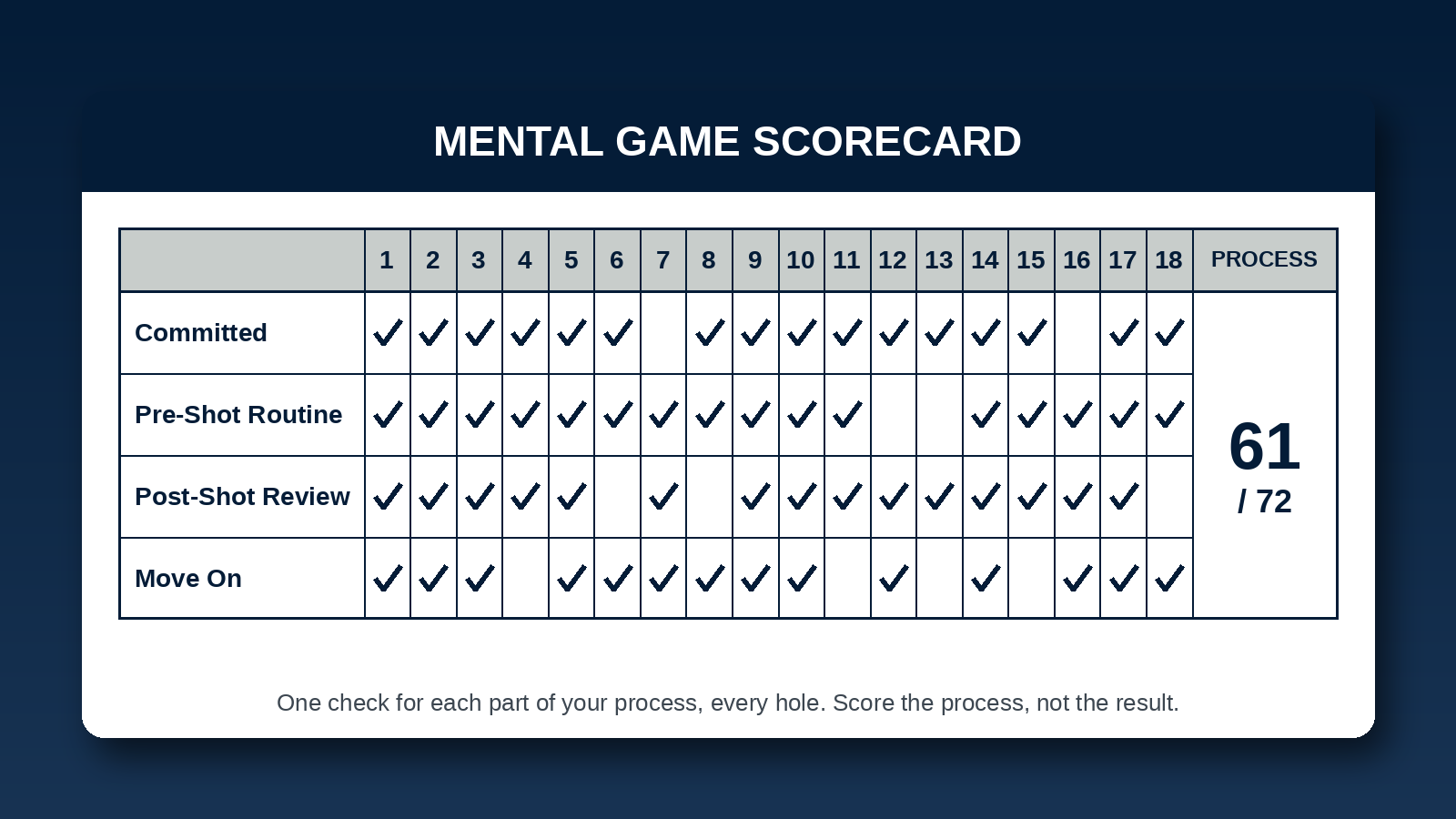
Score your mental game next to your golf score. Track holes where you ran your full routine, shots you fully committed to, how you reacted after bad shots, and whether you breathed between shots. This shows you what is really costing you strokes. Practice your post-shot routine on the range too: hit, check commitment, hands, face, then reset before the next ball.
Step 7: JJ's three ways to file a shot
Every shot goes into one of three boxes. Great shot: enjoy it and soak it in. Acceptable: it finished farther from the hole than you wanted, but in a safe spot that still gives you good odds at par. Learning experience: the result was not what you wanted. Do not get angry at a learning experience. Rehearse the swing you wanted to make, then put the club away.
Step 8: The on-course post-shot exercise
For one practice round, answer this after every shot. Was I 100% committed and did I run my routine with confidence? If no, find what in your pre-shot routine got in the way and make a perfect routine your only goal on the next shot. Do not worry about positions. If yes and it was a good shot, name what you did well and make one practice swing to lock it in. If yes and it was a bad shot, name the result (hook, slice, top, chunk), name the swing flaw that caused it, make the swing you intended, then put the club away. It is over.
Step 9: Find your go-to shot off the tee
On the range, hit 5 balls with every club you would use off the tee: driver, 3-wood, hybrid and 3-iron. Write down the tendency of each club. Then decide how your setup puts that shot on command, starting with ball position. The club with the tightest pattern becomes your go-to when you have to find the fairway.
Use these after every round

Everything you save here is stored in My Playbook.
When To Use It
- After every shot on the course, good or bad
- On the range, between every ball you hit
- When the urge to fix your swing kicks in after a loose shot
- When the round starts to slip and you need your go-to shot
- After the round, when you fill in your Mental Game Scorecard
Common Mistakes
- Changing your swing thought after one bad shot
- Blaming the swing when you did not fully commit
- Ignoring the clubface and chasing body positions instead
- Aiming at the flag when your normal miss brings trouble into play
- Not having a go-to shot, so you have nothing to fall back on
Practical Exercise
Box Breath to Commit
Box breathing is used by athletes, pilots, and first responders to stay steady under pressure. Four equal counts: in, hold, out, pause. Use it as you finish your post-shot routine so the last shot is gone before you walk to the next one.
Pattern: 4-4-4-4 seconds, 3 cycles. The voice counts each second for you.
Ready
Takeaways
- Commitment comes first. If you did not commit, do not change the swing
- About 80% of where the ball starts comes from the clubface
- Only change a swing thought after several committed shots miss the same way
- Know your miss and aim so it stays in play
- Your go-to shot is your safety net when the round gets away from you
- Great, acceptable or learning experience. Every shot fits one box
- Prepare for bad shots before the round so they do not surprise you
Reflect
Use It Next Round
Something not going right on the course?
Tell the AI Coach what happened and get exercises picked for you.
Finished the lesson? Mark it complete to track your progress.